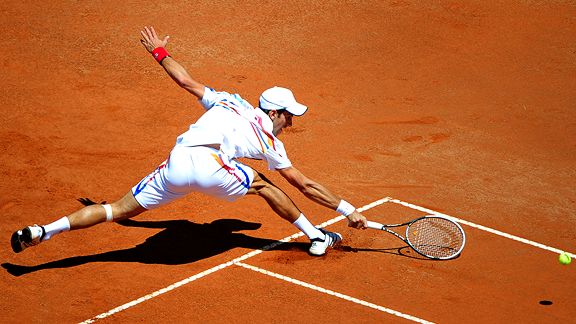
本文取自
http://sports.espn.go.com/sports/tennis/french11/columns/story?columnist=garber_greg&id=6558414
說明了步法、預測能力和其他非擊球技術在網球運動的重要性(我認為在其他運動也是),很值得參考的一篇文章。
By Greg Garber
ESPN.com
The shot gets all the love.
That's the way it is in the bottom-line business of sports. The sweet pass that leads to the overtime goal? The crushing block that springs the running back for a touchdown? The gritty foul balls that allow an at-bat to blossom into a run-scoring double?
No one really cares about what came first. To the eye of the casual fan, this is especially true in tennis.
"Everybody talks about weapons -- the big serve, forehand, backhand," said Sam Sumyk, who coaches No. 4-ranked Victoria Azarenka. "These are isolated shots. Why not
movement? It can be a huge weapon, as well.
It's the key to every stroke."
Ah, movement. It is the very rhythm, the baseline (so to speak) of the game. Movement is everything that happens before the ball strike. It's how the elite players arrive at the desired point of impact -- hence the term "being on the ball." It allows you to take the ball earlier and put yourself in position to hit your best shots, such as running around the backhand.
"It is much more important than ballstriking, that's for sure," insisted three-time French Open champion Mats Wilander. "Usually, the best players in the world are the best movers.
"Movement is why [Novak] Djokovic is the best player right now. It's why Rafa [Nadal] is the best player ever. It's also why Robin Soderling hasn't won a major, or Tomas Berdych, for that matter."
It's all about the journey. Because it is the most cloying of surfaces -- Did you ever try to run on the beach? -- movement on clay is more important than on any other surface. As the French Open unfurls next week, balls will bounce higher, points will last longer -- and more miles will be logged.
Movement has many components. It is the
fitness and
flexibility of Novak Djokovic and Kim Clijsters. The jaw-dropping
speed of Gael Monfils. The world-class
acceleration of Rafael Nadal or Serena Williams or the startling
anticipation of Caroline Wozniacki. Or the eerily
cat-quiet footwork of Roger Federer.
Some players move better from baseline to net, others from side to side, still others diagonally. Some move better on clay, others on hard courts. The sum of all these moving parts:
court coverage.
Jose Higueras, the USTA's director of coaching for elite player development, has coached a number of the world's best movers, including Federer and Jim Courier.
"Because you are very quick doesn't mean you will move quickly on a court," Higueras said from his home in California. "Movement is more about how you perceive the bounce of the ball, assimilate where you are, where the ball is going to be -- and how you are going to get there."
The importance of court coverage
Think of the Olympic sprinter. Pure speed is the only concern. Point A, the starting blocks, to Point B, the finish line. For the 100 meters, it's a straight line, the 200 meters involves a single curve. No major changes of direction; fast-forward only.
Now, consider the degree of difficulty involved in the tennis player's craft: Elevate for a serve, rotate through the ball, check your forward momentum, push off to the left to retrieve the return, stop, execute a swinging backhand, start the feet moving to the right, with chopping steps to get back to the middle of the court, recognize a drop shot, sprint forward, angling to the right, decelerate and chip a forehand into the open court. And that's merely a five-stroke rally. (這就是我喜歡網球勝過跑步或游泳的原因,多變、有趣,動手、動腳、也動腦,需要計畫,也需要臨場應變與反應。)
In the semifinals of the 2009 Australian Open, Nadal defeated Fernando Verdasco in five sets. In a match that consumed 5 hours, 14 minutes -- the longest on record Down Under -- according to the Oradsport tracking mechanism, Nadal ran a total of 2.13 miles. The logistics were staggering; the Spaniard sprinted in all directions, stopping, starting, lunging, jumping, swinging for a total of 1,473 strokes. Then he beat Federer in a five-set final for his first (and only) Australian crown.
Let's see an Olympic sprinter do that.
Todd Martin, who reached the Australian Open in 1994, is one of the game's most cerebral players. He says the technological advances in rackets and strings make movement a critical element.
"The technology -- the advent of polyester strings -- and the skill of the players have promoted just ungodly amounts of topspin without sacrificing pace," Martin said. "The effect is that the court has become much bigger, much wider than it used to be. More balls are in play, and they are tougher to reach.
"As a result, lateral movement is more important now than it's ever been."
Said ESPN analyst Darren Cahill, "If you can't play great defensive tennis, you can't survive. All of the top players, when the shots aren't dropping, they back it up with a Plan B and Plan C."
As ESPN's on-court reporter, Pam Shriver witnesses the speed of the players firsthand.
"Some of these guys are 6-foot-2, and to see their acceleration -- it takes me aback," Shriver said. "The swoosh that they make -- you can almost hear it in the air."
Fitness, the foundation
The best players, particularly on clay, can run for days.
No one preaches fitness -- with such overwhelming success -- more than Pat Etcheberry. He has worked with, among others, Pete Sampras, Monica Seles, Andre Agassi, Courier, Martina Hingis, Jennifer Capriati, Justine Henin, Jelena Jankovic and, currently, Daniela Hantuchova.
"You have to train very hard to play well on clay," said Etcheberry, who also consults for the USTA. "And that means running, lots of running. Nadal does it, Courier and Justine Henin and Sergi Bruguera did it, and it helped them all win the French."
Brad Gilbert, who coached former No. 1 players Agassi and Andy Roddick, thinks
Nadal has the best court coverage on clay.
"Rafa's lung capacity is unbelievable," Gilbert said. "
The most important things in movement are balance and efficiency. Rafa is not really efficient, but his sheer speed is incredible and he's well-balanced."
Djokovic, according to Gilbert, is the better mover on a hard surface.
"I've never seen a guy with the flexibility that he has," Gilbert said. "He's like a ballerina. He made some insane gets at Key Biscayne -- not only getting there, but doing something with it.
On hard courts, no one covers more court than Djoker."
Djokovic's fitness level has been criticized in the past; he has had some notable retirements in the majors. No one was criticizing him when he won his first four tournaments of the year. The difference? Djokovic, who suffers allergic reactions to gluten, has cut out pizza, pasta and breads from his diet.
"I have lost some weight," he told reporters at the recent event in Belgrade, Serbia. "But it's only helped me because my movement is much sharper now."
Speed = commitment = confidence
Nick Bollettieri, only a few months shy of his 80th birthday, has been up since 5 a.m., and he's got more juice than a double espresso.
"You want to know where speed comes from?" Bollettieri says from his tennis academy in Bradenton, Fla. "Let me tell you a story: People see the Williams sisters play and say, 'Holy mackerel, look how quick they are. They just seem to know where the ball's going.'
"Well, 22 years ago, Richard Williams told his daughters back in California, 'I want you to get every ball.' Serena and Venus chase every ball like it's match point.
If you see something with your two eyes, and then wait for your brain to react, it's too late. When you play aggressive, there's no room for hesitation. The ball is hit, and you just go."
Shriver sees this in the evolution of Djokovic.
"Speed is a lot about your attitude," she said. "When you're at your most
confident, you're at the best of your ability. To be a free-mover, you have to be very clear, no gray areas, otherwise you're inhibited.
"Djokovic, he's always been a great mover. With this newfound confidence, he seems to be
reading the court and his speed is even more deadly.
That's because he's not tied up, not worried about his serve and what his forehand's going to do. It's all flowing."
Monfils, by a broad consensus, is the fastest player in the sport.
"The guy's speed is off the charts," Gilbert said, "but he plays so far back that he's not efficient enough."
Added Martin, "There's not a ball in the world he can't run down, but a majority of that is raw explosiveness. He
does not recognize opportunity when it's there, or else he'd be way, way more successful. He's got a big forehand, backhand is adequate, good serve. But he's playing five, 10 feet behind the baseline and never budges.
"In today's game, you better be explosive and efficient. But if you can't get to where the play is in athletics, you can't play."
Happy, efficient feet
Federer, the No. 1 player for 237 consecutive weeks from 2004 to 2008, has seen Nadal and Djokovic slip past him in the rankings.
But there's still one thing he does better than anyone on the planet.
Listen to Higueras, who tutored Federer in 2008:
"
The most economical mover, in terms of how he approaches the ball and sees it, will be Federer. Nadal is incredibly effective, with more force and muscle-driven speed, but Federer is still so fluid.
"His feet are very, very quiet. He never takes more steps than he needs to."
Another piece of the movement puzzle, according to Wilander, is tactical.
"
The smart players," he said, "
hit shots to their opponents and have a pretty good idea what their corresponding shot will be. That always makes you a little quicker out there.
"Roger Federer obviously knows that Robin Soderling has problems running forward, which is why he picks him apart all the time, with drop shots and short-angled balls.
Nadal has an unbelievable ability to catch opponents off guard. He always counterpunches at right time, hits behind guys, throws a curve ball that even David Ferrer can't get to."
Observed Martin: "They all do [footwork] so well now. It's the main reason why there aren't holes in the ground game of the top players. It used to be that one guy moves well to the right but not to the left. Or vice versa. These guys today are just so good from 80 feet away, so adept at handling everything.
"
The best players know if you hit certain shots, it's real difficult for your opponent to hit the ball where you don't want them to."
Anticipation (is making me wait)
Perhaps no one in the game anticipates as well as Wozniacki.
"She moves unbelievably," said Sumyk, who has coached Vera Zvonareva and, currently, Azarenka -- both top-five players. "
Wozniacki sees and reads the ball really well. The toughest players -- Nadal, Djokovic, Federer -- they touch every ball."
Wozniacki is not blindingly fast, but somehow the 20-year-old Dane seems to get to everything.
"I would say that Caroline is one of the great anticipators of the last decade," Shriver said. "It's amazing how often she guesses right. She'll be seemingly out of the play and, boom, she's back in it."
Bollettieri, who has worked with no fewer than 10 No. 1 players, said that movement is Wozniacki's greatest asset.
"What she does is she gets so many balls back the opponent says, 'Screw you,' and overhits into a mistake," Bollettieri said. "It happens all the time, and it's because she moves so well."
It's one thing to run down a ball, but completely different to do something with it from a compromising position. The best players -- Nadal, Clijsters, Djokovic Serena Williams -- do this consistently.
"
Rafa's ability to transition from defense to offense, to make something happen from a ridiculous position, is amazing," Cahill said. "Fed is great at it on clay -- doesn't get enough credit for it. Ferrer is lightning fast and recovers well.
"
The best players are recovering before they even finish hitting the shot. In this game, that kind of movement is imperative."